
The loneliest job
doesn't have to be.
"I had a board, advisors, a co-founder. Nobody I could actually tell the truth to. Then I sat at this table and said the thing I'd been lying about for eight months. Someone across from me said, I did the same thing. Here's how it ended."
Let's clear
the room.
Founders is not a conference, not a Slack group, not a podcast. It is a monthly dinner where six CEOs who have each crossed the million-dollar mark sit across from each other and work. What follows are the three things people assume it is before they walk in.
It's a networking event.
There are no business cards. No pitches. No one is here to sell you anything. Founders is the room after the conference — when everyone's tired of performing.
It's a mastermind group.
Masterminds give advice. Founders gives decisions. The difference is that everyone at this table has skin in the game at the same altitude you do.
You'll hear the same playbooks.
Nobody here read the same blog post. They built different companies, made different mistakes, and they will tell you exactly what those mistakes cost.

The silence after
everyone else goes home.
At 11 PM on a Tuesday, your co-founder is asleep, your investors want good news, your team needs confidence. There is nobody to call. The decision you're sitting with — the one about the VP who isn't working, the term sheet with the clause you don't understand, the co-founder conversation you've been avoiding for four months — that decision doesn't fit in a Slack message.
Founders was built for that 11 PM. Not as a hotline. As a room full of people who have sat at the same table and know exactly what that silence sounds like.
"I realized I hadn't been honest with anyone about the company in over a year. Not my board. Not my wife. The table was the first place I said it out loud."
— Solo technical founder, fintech, $4.2M ARR
The moments that
changed the company.
All members are anonymous by design. These are real stories, told with permission, with identifying details changed. The decisions, the doubts, and the outcomes are intact.

The co-founder conversation.
Eighty-hour weeks. A co-founder who had stopped building. A cap table that was going to become a problem at the next round. Three board members who only wanted the highlight reel.
"I put the org chart on the table. Someone said — that's not an org chart problem, that's a conversation you haven't had. They were right. I'd known for nine months. I just needed someone to say it."
The conversation happened six days later. The co-founder transitioned out. The round closed cleanly. The company is still running.


The structure
behind the table.
There is nothing mysterious about the format. The mystery is what happens inside it — which is a product of who is in the room, not how the room is arranged. Here is the room.
Six seats. No more.
Every table is capped at six founders. Small enough that nobody hides. Large enough that the range of experience is real. The composition is deliberate — no two members from competing industries.
Monthly cadence.
One dinner per month, three hours, in person. Between sessions, a private channel for the moments that can't wait. The rhythm is slow enough to be sustainable, frequent enough to matter.
Chatham House rules.
What is said at the table stays at the table. Members may use insights from the conversation, but they may not attribute them. This is the rule that makes honesty possible.
Facilitated, not lectured.
There is no speaker. There is no curriculum. Each session is structured around two or three real decisions brought by members. The facilitator keeps the room honest, not on-topic.
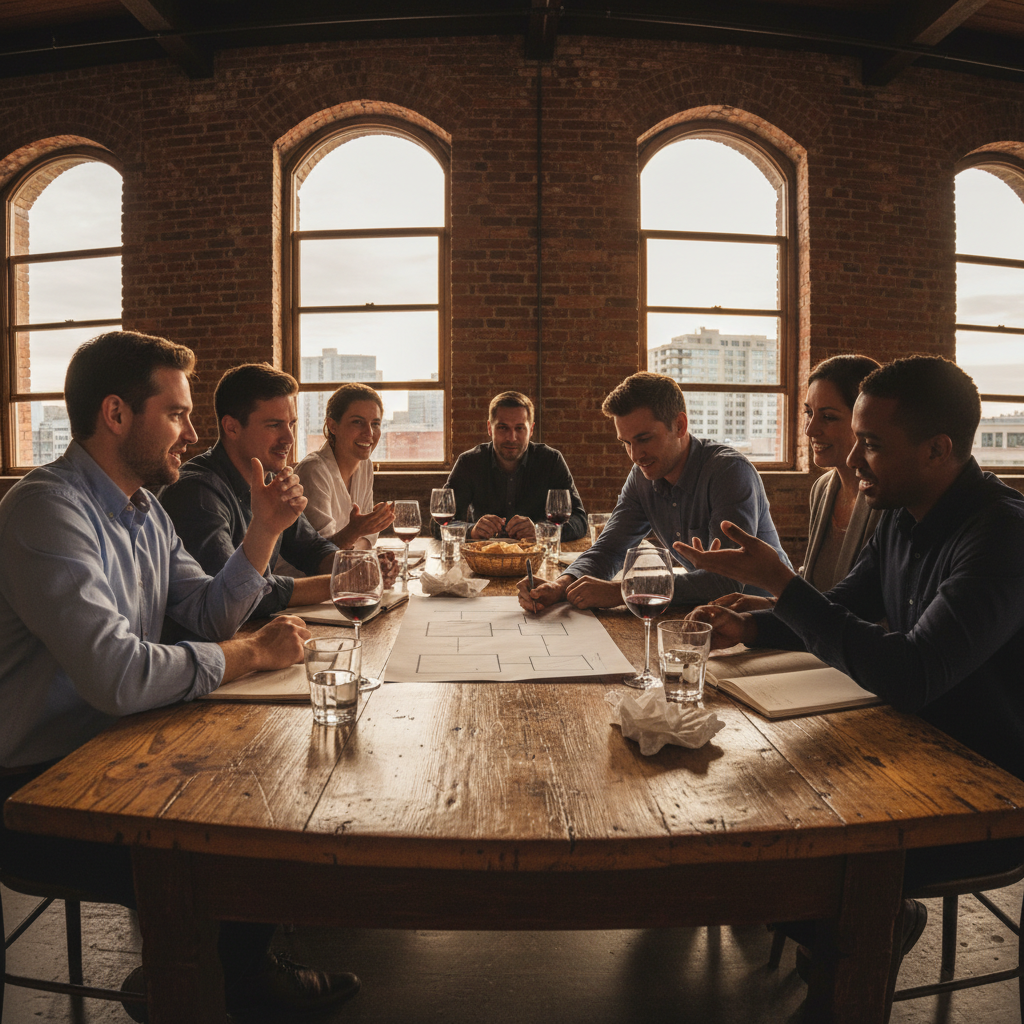
Wine glasses half-empty.
Jackets off. Someone drawing
an org chart on a napkin.
The sessions don't end on time. They end when the work is done. Members have described the feeling as the exhale at the end of a long dinner with people who finally, fully understand.
"The only room where I don't have to pretend the company is fine when it isn't."
— Series A founder, marketplace, $2.8M ARR
The door is
open.
Applications are reviewed by hand. We look for founders who are honest about what they don't know, and who've built something real enough to have something to lose. One seat opens per quarter.
Apply for a Seat
This takes four minutes. The last question is the one that matters.
The Case for Founder
Peer Groups
A twelve-page PDF on why isolation is the most underreported risk in early-stage companies — and what the research says about structured peer accountability. No pitch. Just the evidence.
"The table is already set.
There's one chair left."